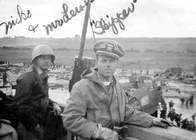
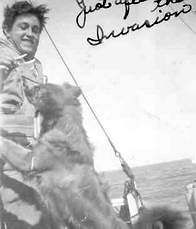
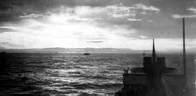
June 1944
June 6, 1944
D-Day - Normandy Invasion
Operation "Overlord" and "Neptune"
Background
Much has been written about D-Day and its pivotal role in world
history. A large collection of materials found in a
General Overview of D-Day provides information, photos, combat videos
and other related materials pertaining to the planning, events and actual landings at Omaha,
Utah, Gold, Juno and Sword Beach. Also, additional details noted in the World War II campaign summary includes logistical information related to the
largest ground
and naval forces ever assembled that were needed for Operation Overlord and Neptune.
As D-Day was unfolding on French beaches, President Roosevelt made this statement to the American public concerning
the Invasion at Normandy.
"Almighty God: Our sons, pride of our nation this day have set
on a mighty endeavor, a struggle to preserve our Republic, our religion,
and our civilization, and set free a suffering humanity...They will
need Thy blessings. Their road will be long and hard. For the enemy
is strong. He may hurl back our forces. Success may not come with
rushing speed, but we shall return again and again; and we know
that by Thy grace, and by the righteousness of our cause, our sons
will triumph. They will be sore tired, by night and by day, without
rest-until the victory is won."
Franklin Delano Roosevelt (June 6, 1944)
as published in Tom
Brokow's "The Greatest Generation"
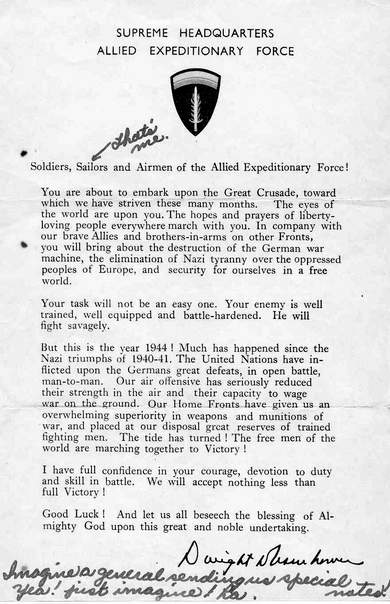
General Dwight D. Eisenhower, Supreme Commander, Allied Expeditionary
Force gave the following note to all those about to participate
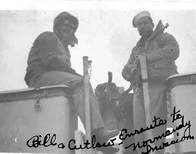
in the Invasion of Normandy (Dad made the annotations on his note):
USS LCI (L) 35 Participation-Sword Beach
June 1, 1944
In getting ready for the invasion, the LCI (L) 35 began preparations
for carrying troops on Thursday June 1st. This was the same day
that HMLCI 111 backed into the bow of the LCI (L) 35 putting a 10
inch diameter hole in its starboard peak tank.
June 2, 1944
On Friday June 2nd the entire crew, (except
for 4) mustered on the docks in undress blues and attended pre-invasion
lectures and movies from 1130 until 1445. At 1200 "All liberties
were cancelled until further notice" and by 1500 the "Ship has been
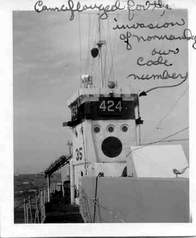
stripped of unnecessary gear--finished camouflage painting--now
ready and waiting to take on troops."
June 3-4, 1944
On Saturday June 3rd and Sunday June 4th, just normal cleaning was
undertaken while the ship awaited troops to board.
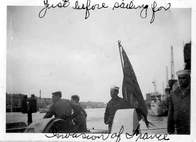
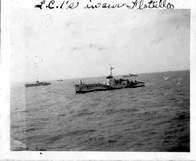
The LCI (L) 35 with the 190 troops on board preparing to leave for
the invasion of Normandy is shown in the photo on the right.
June 5, 1944
On Monday June 5th the following entries
of note were made in the LCI (L) 35 deck log.
*At 0415 General Eisenhower gave
his order "Okay, Let's Go!" and the Invasion of Normandy began.
|
Time |
LCI (L) 35 |
|
1115 |
Ship has "Ready-Duty" for the day |
|
1530 |
British troops coming aboard - 190 men |
|
2010 |
Got underway-loaded with troops-Left for the Invasion of
Normandy, France |
|
2045 |
Crew was given brief talk-then donned chemically treated
gas protective clothing-gas masks-over shoulder and helmets.
Went to battle stations for entire trip. |
|
2100 |
Sailing with convoy of USS LCIs and HM LCIs |
Courtesy of National Archives
June 6, 1944
LCI (L) 35 - Landing at Sword Beach
The beach obstacles at Sword confronting the troops landing
were extensive but the dunes were not as high as Utah, and instead
of bluffs behind the seawall there were French vacation homes. Some
of these were torn down to give a better field of fire for the German
troops, while others were used as strong points. There were casements,
large and small scattered along the coast.
The plan for Sword called for the British 3rd Division, with French
and British Commandos attached, to push across
Sword Beach then pass through Ouistreham to capture Caen and
Carpiquet (Airport).
From Stephen E. Ambrose,
D-Day June 6, 1944-The Climactic Battle
of World War II
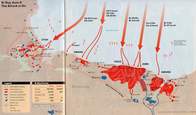
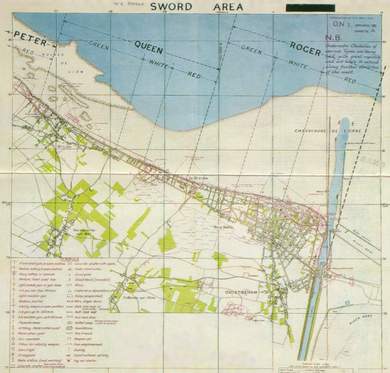
The following map provides an overview of the D-Day Landings and
includes the Sword Beach Area near the Orne River and City of Ouistreham.
The map below indicates the LCI 35 landed in the Roger Red Sector of the Sword Beach landing
area. Other documents and maps indicate that the actual landing site designations may have been changed and that the LCI 35 landed in the most easterly position (exit 26) of the Sword Beach Queen Red Sector.
The two aerial views below were taken sometime during the D-Day invasion on Sword Beach. These photos were obtained by Richard Anderson from the National Archives.
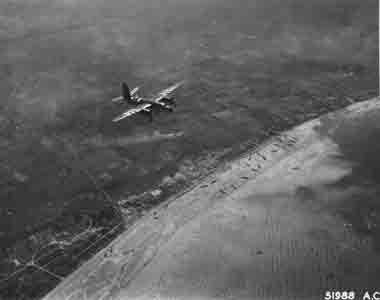
Early morning (0800) Aerial View of Sword Beach
D-Day June 6, 1944
This photo shows a B-26 Marauder aircraft and most likely LCAs and LCTs on the beach as part of Assault Group S-3 with the 8th British Infantry Brigade. The LCI 35 landed to the left of the 2 ships laying parallel to the beach in the center of the photo.
Photo and Information from British National Archives
Courtesy of Richard Anderson
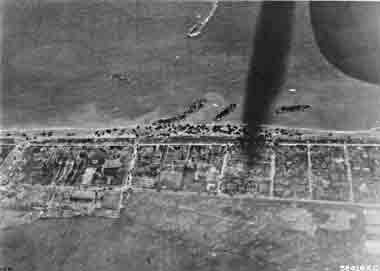
Aerial View (around 0900) of Sword Beach
D-Day June 6, 1944
The photo above, probably taken from a special reconnaissance aircraft, reveals many more men and vehicles are already on the beach but prior to the Assault Group S-2 landings. The LCI 35 landed on the far right in this photo.
Photo and Information from British National Archives
Courtesy of Richard Anderson
From the LCI (L) 35 Deck Log - June 6, 1944
|
Time |
LCI (L) 35 |
|
0800 |
Nearing Coast of France |
|
1025 |
Everyone went to Beaching Stations |
|
1030 |
Started towards beach with ramps in dropping position |
|
1100 |
USS LCIs' and HM LCIs broke columns-now going into beach-ships
abreast of each other. British troops ready to disembark |
|
1120 |
Hit beach-smooth landing. Sword Area near River Orne |
|
1122 |
British troops started to disembark. Under enemy fire while
on beach. Shells landed close |
|
1130 |
Troops Unloaded |
|
1132 |
Took in ramps |
|
1135 |
Started pulling ship off beach with stern anchor. Could
not get anchor up. It was caught on submerged wreckage of an
Army Tank. While repeated efforts were made to hoist anchor,
ship was drifting to port towards two small boats wrecked near
shore. Seeing imminent danger of collision, Mr. D.A. Lewis (CO)
ordered anchor cable cut, then with skillful maneuvering backed
the ship off beach. Lost anchor and about 500 ft of cable. |
|
1140 |
Off beach-headed to sea |
|
1145 |
Underway for rendezvous area |
|
1201 |
Off coast of France near town of Ouistreham, Normandy |
|
1230 |
Forming disposition in convoy of USS LCIs' and HM LCIs'
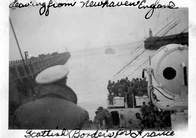
underway to Newhaven, England |
|
1245 |
Beaching stations secured-men went to battle stations |
|
1600 |
Pilot House and engine room watches were relieved |
|
1800 |
All's well |
|
1945 |
Watches were relieved |
|
2200 |
Sailing along with convoy |
Courtesy of National Archives
D-Day - H-Hour
at Sword Beach
From the Conning Tower of LCI
35
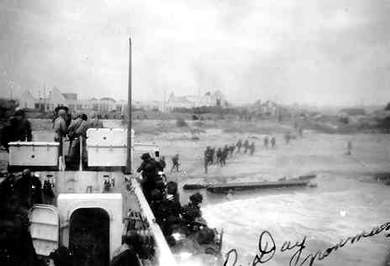
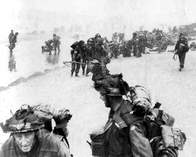
British troops disembarking from LCI (L) 35 onto Sword Beach on
D-Day. The disembarkation occurred between 1122 -1130 while the
ship was under enemy artillery fire from German 88's.
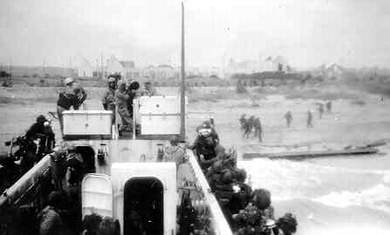
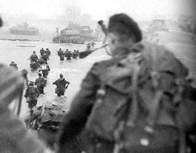
This photo was also taken
during the eight minutes that the LCI 35 was disembarking troops.
This photo shows less British Soldiers on the beach than shown in
the other photo above.
|
Clarence
Robins |
Clarence Robins
believed that German 88 artillery fire came close to the LCI
35 during the Invasion. So close in fact that he thought that
the LCI (L) 35 was being "bracketed". Enemy gunfire
landed shells on both sides of the ship. Fortunately, when Skipper
Lewis made the decision to cut the cable from the submerged
army tank, he moved the ship right before an enemy shell exploded
in the ship's wake. The shell had landed in the exact
spot where the LCI (L) 35 had just moved. He also indicated
that Skipper Lewis handled himself well during the Invasion. |
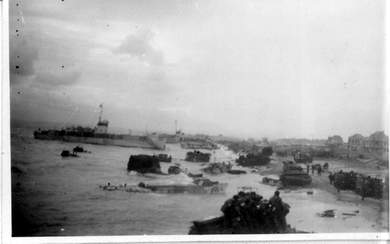
Photo Courtesy of Joe Logan Sr. (LCI 219 and
LCI 216) and Joe Logan Jr.
LCIs are shown disembarking troops on Sword Beach.
These LCIs probably were a little west of the landing area of LCI
35.
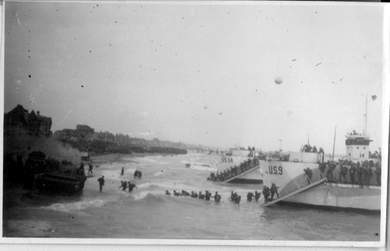
Photo Courtesy of Joe Logan Sr. (LCI 219 and
LCI 216) and Joe Logan Jr.
The photo above showing the landing of troops from
the LCI 9 and LCI 14 is also believed to have been taken on Sword
Beach.
British LCI and LCT Association Archivist Comments on Sword
Beach
Additional information pertaining to the
LCI (L) 35 landing at Sword Beach was initially provided by Tony Chapman,
the official archivist for the British LCI and LCT Association. More details were added by Richard Anderson, a researcher who obtained most of the information from the British National Archives at Kew and are from the Operation Neptune planning documents and after action reports. Most of his research is related to the initial assault waves, especially the Landing Craft Tank (LCT) landings with the British "Funnies". He is scheduled to have a book on the D-Day Landings published in July 2009 (Stackpole Books).
The information below regarding the Sword Beach landings was provided by Tony Chapman and Richard Anderson.
The Invasion Landings at Sword Beach
LCI (L) 35 landed with Flotilla 2, Group 4 Division 8 of the USS LCIs assigned to the "I" Landing Craft Tank Squadron under the command of Lt. Commander M.O.W. Miller,
RN.** According to both Tony Chapman and Richard Anderson, the LCI (L) 35 was part of the Intermediate Group S2 (second wave) assigned to carry English soldiers. In addition to the US LCIs, Miller's squadron
was comprised of the British 251st and 263rd LCI (L) Flotillas in company
with the 40th, 42nd, and 48th LCT Flotillas (Mk4's).
There were a total of 10 USS LCIs participating in the landing
at Sword Beach. These included LCI (L): 9, 12, 13, 14, 15, 16, 33, 35, 193, and 283.
The 251st LCI (L) Flotilla was comprised of LCIs: 180 (F), 130, 131, 134, 183, and 291.
The 263rd LCI (L) Flotilla included LCIs: 380 (F), 126, 164, 165, 169, 171, 179, 181, 300, 377, 378, and 379.
The Queen Red Assault Troops from the 8th Infantry Brigade included the following:
1st Special Service Force
3rd Commando
4th Commando
6th Commando |
45th Royal Marine Commando
79th Squadron, 5th Assault Regimen, RE
2nd East Yorkshire Regiment |
**Note: Lt. Commander Max Owens Waldemar Miller's (M.O.W. Miller) recollections provide
" an incisive and often amusing account of a Landing Craft Tank Squadron from early training in the harsh, cold winter of 1943/44 in the Moray Firth in Scotland to the hazardous landings on the Normandy beaches on D-Day June 6 1944".
(For his actions in Normandy, Lt. Commander M.O.W. Miller received the Royal Navy Distinguished Service Cross.)
The first assault went to the Assault Group S3 of the British 8th
Brigade. Tony indicated that they suffered "grievously" going ashore
at Sword. Tony also indicated that the reserve British 9th Brigade of
Assault Group S1 was the last assault group at Sword Beach.
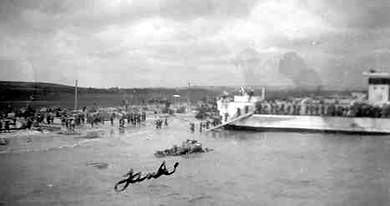
Dad captioned the photo
above "First Landing-Shells are Popping".
Tony also raised an interesting point while providing information
on the Sword Beach landings. It appears that the US LCIs may not
have been part of the original plan for the Sword Beach landings,
but because of the shortage of available British LCIs, were included
to make up for the shortfall. This fact was later confirmed by a
Flotilla 251 officer of the Royal Navy and this finding was further substantiated by Richard Anderson's research. The initial planning for the Allied Naval Deployment for "Neptune" listed LCIs 33, 35, as part of LCI (L) Flotilla 2, Group 5, Division 7 and were to be included in Assault Force U scheduled for H-Hour 0630. However, LCI 33 and LCI 35 were redeployed to Group 4, Division 8.
Sword Beach Landing Area (Exit 26) as of Summer 2007
According to Colin Henderson, who has done extensive research on the Sword Beach landings, the LCI 35 landed in front of exit 26 (the last and most easterly). The 2 photos of the LCI 35 above on H-Hour show troops disembarking from the ramps and moving diagonally for exit 25. Many of the buildings from World War II are still standing, and according to Colin, many of these buildings were originally to house German Prisoners from the First World War. They were later used as holiday camps between World War I and World War II. The photo below shows Sword Beach as it appeared in the summer of 2007.
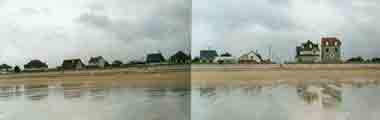
Photo Courtesy of Colin Henderson
Taken Summer 2007
**LCI 85, 91, 92, 93, 232, 497, 553, Sunk off Northern France, 6 June 1944